Showing posts with label Mythology. Show all posts

Thursday, December 12, 2013

Hunger Games = Minotaur?


A while back, I did a post about the similarities between “The Hunger Games” and “Battle Royale.” Many people have accused Suzanne Collins of “ripping off” “Battle Royale.” I still stand by what I say about it being foolish to think that they do not invite comparison, but “The Hunger Games” is still the better of the two and has plenty to be its own story. As I watch the movies though and read the story, my background in mythology always kicks in for some reason. I see the plight that Katniss goes through, I think of why she is there, why the capitol does what it does, and then draw parallels to another story that is well known and very similar. I think of the story of Theseus and the Minotaur.
 
“The Hunger Games” is a tournament where youth is recruited to be sacrificed because of a penance that surrounding districts must pay for losing a war to the governing body also known as the capitol. The districts send a young man and woman to die in an arena as a reminder of the capitol’s power.

In the story of the Minotaur, Greece must send seven sons and seven daughters to Crete to be sacrificed as penance for their actions. In some versions of the story, King Minos of Crete sends his son Androgeus to compete in the Pan-Athenian games in Athens. Androgeus does so well in the games that people in Athens become jealous enough to send assassins to kill him. When King Minos finds out about his son’s death, he demands that Greece send Minos the assassins for execution. Nobody knows who the assassins are. Greece pays Minos by sending the entire town.

The other version of the story has Crete defeat Athens in a war. In both versions of the story, Greece must send seven sons and seven daughters to be executed every set number of years. This version of the story mirrors “The Hunger Games.” Some differences come in at this point. The biggest difference being that the seven sons and daughters are to be fed to the Minotaur while the tributes must kill each other until one remains. 

Like most Greek myths, a hero emerges to kill the Minotaur and save the people of Athens. The hero’s name is Theseus. When it comes time to pick the seven sons and daughters, Theseus volunteers to take the place of one of the boys. Wait a minute, he
volunteers? Where have a seen that before?
Both Katniss and Theseus have outside help. Katniss has the help of Haymich and her sponsors, while Theseus gets help from King Minos’ daughter. Both of these assistants give the heroes things they need to aid them in their quest. Theseus gains a ball of string that helps him find his way out of the maze, while Katniss gets burn medicine, food, or anything she may need to stay alive.

One big difference that may still be on your mind is the fact that Theseus has to face a Minotaur, and Katniss does not. While Katniss does not have to face a Minotaur, she does have to face beasts that are hybrids. The Minotaur is a hybrid of a bull and a human. Katniss must face a few different hybrids. The most disturbing of these creatures can only be read about in the books. When there are only a few tributes left, Katniss must not only face the other tributes, but a pack of dogs that have features of the fallen tributes. At one point Katniss wonders if the capitol actually took the eyes from the fallen tributes and placed them in the dogs. This puts a half man half-animal creature in the arena with Katniss.
 
We also have the symbol of “The Hunger Games,” a bird called a mockingjay. The mockingjay is a hybrid of a mockingbird and a jaberjay, another creation of the capitol. Katniss herself becomes a symbol of the rebellion of the districts later in the story and is referred to as the mockingjay. The Minotaur becomes the symbol of Theseus’ story just as much as the mockingjay symbolizes Katniss’ story.
What this comparison boils down to is a basic fear of war. In both stories, young people are drawn into a situation that means their death. When there is a war, young people are called upon to give their lives. Whether the cause is just or not, the fear of this situation is something we all carry inside of us.

I do not know if Suzanne Collins is a big fan of Greek mythology. I am willing to bet she has a working knowledge of the Minotaur’s story. Whatever the case is, there will be more stories that can be traced back to the story of Theseus and the Minotaur. It is a story that will always remain relevant, not matter how obscure it may seem to people.


Please leave comments and follow if you like this article.

Tuesday, October 15, 2013

Hunger Games vs. Battle Royale

One of the most popular stories of our times is The Hunger Games. It is destined to become a classic, the first book is already a movie, and even the more casual readers could have a long discussion on its impact in society. Yet despite how great it is, there is a dark cloud looming over it. Many people are saying it is just an imitation of the story Battle Royale. battle royale with cheese

 I have read both books, and have seen both movies. It would be stupid to say that they do not at least invite comparison. In fact if you have read Catching Fire, there is even more room for it. While I do believe there is plenty of room for both stories in our world, I do feel a need to address this idea of Hunger Games just being Suzanne Collins version of a story that has already been done, and if so, does it deserve the praise and accolades it receives.
praise
First, we will look at the basic premises. Hunger Games is a dystopian future in which children are chosen from twelve distinct districts to meet in an arena where they must fight to the death. Once a year each district holds a public “reaping,” where one boy and one girl are chosen at random by drawing their name out of a hat (or glass bowl if you want to get technical.) At this point, another child may volunteer to take his or her place assuming the volunteer is the same gender. This option to volunteer becomes a major plot point for both the protagonist and some antagonists.


description
Battle Royale also takes place in a dystopian future in which children are chosen at random to go to the arena and fight to the death. There is no public reaping. Instead a class of students are chosen by the government. They are kidnapped and taken to the secrete arena while they are unconscious. There is no volunteering, and you are giving no warning. blow up blow up

In the case of the Hunger Games, the reason for the tournament, or pageant as they like to call it, is to keep the districts in line. They pay this penance for rebelling against the capitol many years prior. In Battle Royale, there is no real set reason for it. The beginning of the book mentions experiments run by the government. The movie talks about a law that was passed to try to weed out who, in the government’s eyes, are week. I have read rumors about population control coming into play. The truth is there is no real logic behind it. When it comes to premise, I say Hunger Games get the nod.
love that

Next, let us compare our two protagonists. First, we have Katniss Everdeen, a young woman from the poorest district who struggles to survive while taking care of her younger sister and mother. She volunteers to participate in the Hunger Games when her sister is chosen. Battle Royale we have Shuya Nanahara. He does not volunteer. He is there because his class is. He does care about his fellow classmates, many of the girls have a crush on him, but in the end, he is just there to survive. If not for an alliance he forms, he would probably be dead. Point goes to Hunger Games. thank you

Now lets look at some antagonists. I guess you could call each respective government the real antagonists. The immediate threats though are the people who the protagonists have to face in their respective arenas. In Hunger Games, Katniss must go up against volunteers who have been training their whole life to compete in the game. They are known as “careers”. To be honest, they are not the real threat they could be. They die quickly and when two of them are allowed to team up, they do not take advantage of it.
 lover boy

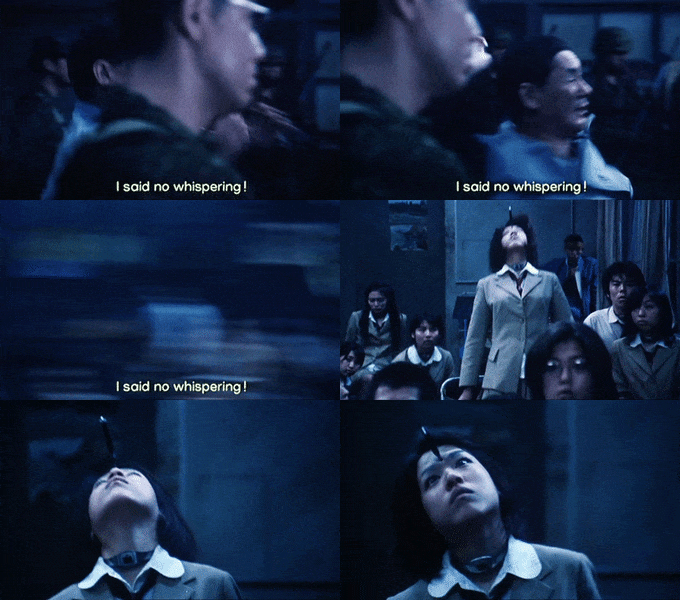
Battle Royale is about kids that are all from the same class. They have known each other for most of their lives and they had time to form friendships, relationships, and rivalries. The most dangerous classmate though is Mitsuko Souma. Oh shit She is the beautiful mean girl that takes her game up about ten notches and kills a good portion of the class before she is taken out. Two students have been through the program before the story takes place. One is Shuya’s ally; the other is the most feared male antagonist who dies last. In the book, it is his first tournament. All of these enemies are far more threatening than anything the Hunger Games has to offer. The point goes to Battle Royale.
no whisper everyone kills
The Hunger Games has a love triangle in it…. Yeah okay, point to Battle Royale on that one.

I think what it really comes down to is which is really the better story? I think one needs to look at the two authors and ask which one did what he or she set out to do. Suzanne Collins is a television writer, so she has extensive knowledge on how television stories go. She is also an American. Many Americans think the Hunger Games is where we are headed, or at least could see us going there. The Hunger Games are televised for all of the districts and the capital. It is made public so there is a lot of pageantry and forced drama. Are today’s television shows very different? Nobody actually dies in them, but with shock value becoming more sought after, and yet harder to come by, real deaths may be the path we are headed down. Koushun Takami, the author of Battle Royale has a background in journalism before he became a novelist. He has lived in Japan his whole life. In his personal interview at the back of the book, he talks about how Japan has always felt constricting to him and how nothing ever changes because nobody ever demands it. The government makes a law that nobody likes, the people do nothing about it. Keep in mind these are the opinions of the author and not me. He has actually lived in Japan though and I have not. I guess his point was that traditions are going to lead to people being sacrificed by the government for no discernible reason. He also has a great history of being a horror fan. He is a fan of both Stephen King and HP Lovecraft. Battle Royale may not be a scary book, but it is dark and Takami is not shy about violence. As far as my original question of does the Hunger Games deserve to escape the shadow of Battle Royale, let me ask a question. How many of you would have heard of Battle Royale if not for this controversy. scarred face

Yes, Battle Royale did have a following before the Hunger Games came out. Yes, I am sure it was very big in Japan and that particular region of the world. Hunger Games though has reached a world audience. It is because of that sphere of influence that people are comparing it to Battle Royale. While Battle Royale, may have a deeper meaning, and more of an emotional impact as far as how the characters are effected, the Hunger Games is better written, is better at holding a reader’s attention, and has a more focused premise. Battle Royal may have done it first, but Hunger Games did it better.

victory

Saturday, October 12, 2013

Welcome to my blog!


My name is Ian Anderson. I started reading mythology at the ripe age of…well I was very young. I can remember my very first book of Greek Myths given by a tutor that my parents hired to help me with my English. Many of you may have heard of it: D'aulaires book of Greek Myths. All the pictures and different colors fascinated me. It was showing people doing things that I had never seen before, and for some reason that spoke to sense of being.

As interesting as it was however, it was still just a book. Even before PlayStation, X-Box, I-phone, or even the internet, books still had to compete for children's attention against things like television, Atari, and hand held electronic games that did nothing but beep at you and moved dots across a screen. Of course, by screen I mean a dark glass panel that would have an army of monochrome lights ready to light up at any given moment.

    I think the real turning point for me was an episode of the "Superfriends". For those of you who do not know what that was, it was a watered down kid safe version of the justice league. The vague recollection of the episode was that somehow they ended up on this island where they had to face off against monsters from Greek Mythology. Superman had to face the Minotaur, Wonder Woman went up against Medusa, Batman and Robin had to solve the riddle of the sphinx, and Aquaman had to retrieve the Golden Fleece from an invisible man. How talking to fish gets you out of that one, I will never know.

After that episode, I wanted my tutor to show me the stories that involved these stories. I also bugged my parents to take me to see the original Clash of the Titans. I will admit that it was a bit scary for me at the time and I did spend a fair portion of the movie with my eyes covered, but remember I was a small child at that point. From that point, I was hooked. I never looked back, I never regretted it, and it keeps getting better the more I dedicate myself to it.

As I got older, I began to branch out discovering that there was more to mythology than what the Greeks contributed. I first learned about Norse Mythology the same way most people these days are, the comic book Thor. I first read the books not realizing that there were tales as old as the Greek Myths that dealt with, Thor, Odin, Loki, and Baldur to name a few. To this day Greek Mythology is still my favorite, but the Norse traditions are a close second.

Eventually I started to learn the stories from Egyptian, Hindu, Aztec, and Japanese Mythologies. Lately I have delved into Irish/Celtic Mythology, and even read a bit about Voodoo. They have a few things in common, many gods that have different influences on our world and very human like personalities, emphasis on heroism, and an underlying warning against arrogance, nature, and death.

Fast forward to present day. Now I am a published author of a series called Modern Disciples. I have already published the first three volumes in the series. The story centers around six children of gods, each from a different pantheon. These children called disciples are the god's eyes, ears, and hands on earth as they protect humanity from the titans and their creatures called spawn. A small sample of the spawn include, maenads, satyrs, dark fairies, Nemean beasts, giants, even vampires and werewolves are thrown into the mix, although slightly.

In future, I plan to write more in depth of the characters from the story, where I get my ideas from, the myths behind the Modern Disciples, and I will do some reviews of books that I have read having to do with mythology and other topics that interest me. I may even write some supplement stories that add to the series. I am always open to ideas though so if there are any topics you would like me to discuss feel free to leave them in the comments below.


Ian Anderson